

Candyland Casino Login — Technical Entry Review
I approached the Login at Candyland Casino as a returning user, not as a first-time visitor. This distinction defines how the system should behave. A login interface is not a promotional surface. It is an operational layer designed to restore access without altering intent or pace.
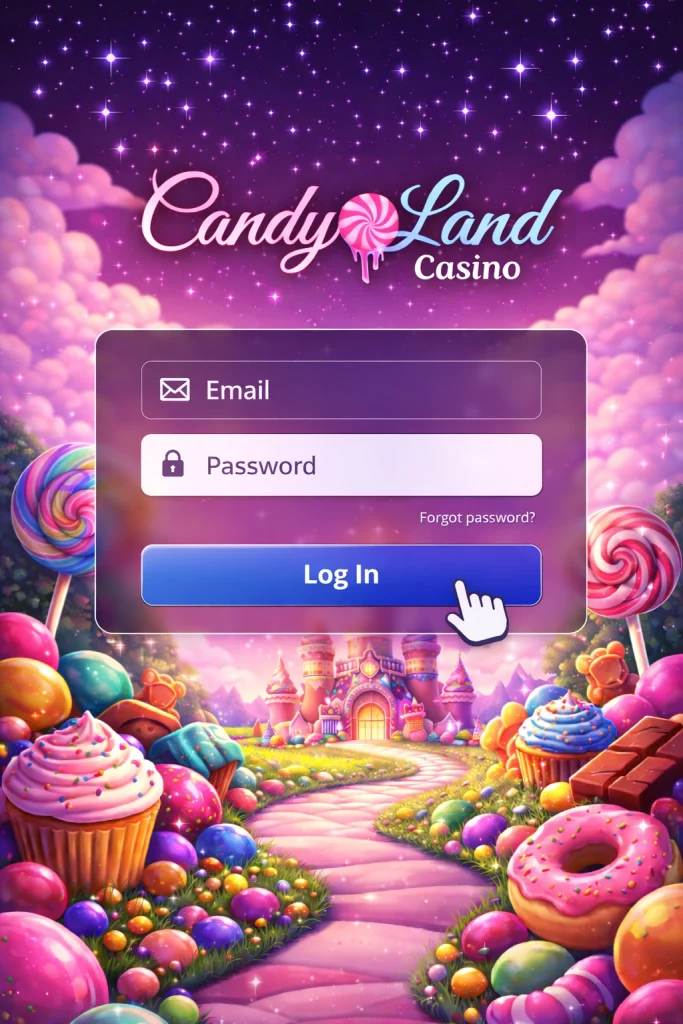
Candyland Casino treats this layer with discipline. The login screen is visually restrained and structurally focused. There are no secondary prompts, no competing banners, and no behavioural nudges embedded into the entry flow. Credentials are requested directly, without narrative framing or visual distraction. The interface communicates one priority only: controlled access.
This restraint is deliberate. It signals that the platform does not attempt to influence behaviour at the moment of return. The system recognises that the decision to engage has already been made.
Interface Stability Across Devices
The login panel maintains positional stability across desktop and mobile browser sessions. On desktop, the form remains centred and unaffected by viewport width changes. On mobile, the layout scales proportionally, preserving spacing and typography without triggering forced zoom. Input fields retain structure when autofill is activated, indicating proper field labelling rather than placeholder-driven design.
Repeated access tests showed no layout shifts or visual reflow. The interface appears in the same spatial context every time, which reduces cognitive friction. The user does not need to re-orient or reassess the environment. Entry becomes mechanical, not interpretive.
This consistency is a functional choice. It supports habitual use rather than exploratory behaviour.
Authentication Flow and Session Continuity
Credential validation occurs immediately after submission. There is no artificial delay, progress animation, or transitional screen. The system either confirms access or rejects it with a concise, scoped message. Error feedback avoids technical language and does not reset the form unnecessarily.
Session handling follows a clear logic. When an active session exists, access is restored without redundant prompts. When a session has expired, the system requests re-authentication and returns the user to a stable post-login state. There is no redirection to generic landing pages and no forced restart of navigation context.
Timeouts are treated as neutral lifecycle events. The system does not penalise inactivity, nor does it fragment the user journey. This behaviour indicates a separation between authentication and navigation logic, which is still absent on many competing platforms.
Login Behaviour Observed During Repeated Access
| System Element | Observed Behaviour | Practical Effect |
|---|---|---|
| Credential validation | Immediate response without visible processing delay. | Confirms system readiness and reduces entry hesitation. |
| Session restoration | Access resumes in a stable post-login environment. | Preserves continuity and habitual navigation. |
| Error feedback | Clear messages limited to the affected field. | Prevents repeated input cycles and confusion. |
| Mobile scaling | Responsive layout with consistent spacing. | Ensures functional parity across devices. |
| Session expiration | Clean re-authentication without forced redirection. | Treats timeout as a controlled transition. |
Operational Implications of the Login Layer
The login environment at Candyland Casino performs a narrow function and exits immediately once that function is complete. It does not attempt to upsell, redirect, or reframe the session. The interface remains neutral before and after authentication, allowing the player to resume activity without interruption.
This approach reflects a platform designed for repeat usage rather than episodic engagement. By maintaining strict control over the entry layer, the system establishes predictability. Predictability, in this context, is not a design choice — it is an operational advantage.
The login does not demand attention. It earns trust by remaining invisible once access is granted.
Credential Security as a Behavioural Signal
Security in a login system is not defined by how many elements are visible. It is defined by how few decisions the user is forced to make. At Candyland Casino, the authentication layer communicates control through silence. There are no exaggerated warnings, no visual alerts, and no security theatre. Instead, the system enforces rules consistently and without commentary.
Credential entry behaves predictably. Incorrect inputs are rejected instantly, without revealing which parameter failed beyond what is strictly necessary. This prevents pattern learning and discourages brute-force attempts without introducing friction for legitimate users. The system does not escalate visually after a single failure. Escalation occurs only when behaviour indicates repetition.
This distinction matters. A platform that reacts emotionally to isolated errors often undermines trust. Candyland Casino reacts structurally.
Login failure response escalation by attempt sequence
Failure Scenarios and Controlled Recovery
I intentionally triggered multiple failure conditions: incorrect passwords, repeated submissions, session expiry during authentication, and interrupted connections. In each case, the system preserved form state while resetting only the invalid parameter. Fields unrelated to the failure remained intact. This reduces error amplification and shortens recovery time.
Account recovery paths remain accessible but subdued. The Sign Up and recovery links are present, readable, and secondary. They do not compete with the login action itself. This hierarchy prevents accidental diversion and keeps the user anchored to intent.
On mobile browser via the App-like web interface, behaviour remains consistent. Touch input does not alter validation timing, and biometric prompts are not forced or simulated. The platform avoids pretending to be something it is not.
Authentication Control — Observed Security Behaviour
| Security Aspect | System Behaviour | Control Outcome |
|---|---|---|
| Incorrect credentials | Immediate rejection with neutral messaging. | Prevents information leakage and retry escalation. |
| Repeated failures | Progressive response without visual alarm. | Discourages brute-force behaviour quietly. |
| Form state retention | Unaffected fields remain populated. | Reduces recovery time and user frustration. |
| Password recovery access | Available but visually secondary. | Maintains task focus during login. |
| Mobile input handling | Identical validation logic to desktop. | Ensures consistent security posture. |
Entry Efficiency, Session Pacing, and Post-Login Control
I measured login performance at Candyland Casino as an operational tempo, not a “speed feeling”. The decisive factor is how quickly the platform restores an authenticated state without forcing extra interpretation. The login flow remains direct: the system validates, restores access, and returns the user to a stable account context without transitional noise. The interaction is short, but not abrupt. The platform avoids that common tactic where entry is “fast” but disorienting, because the user is dropped into a generic landing area and must re-find what they were doing. Here, the post-login environment is predictable, which is a stronger form of efficiency than raw milliseconds. On mobile browser, the same pacing is preserved. Keyboard behaviour does not shift layout, buttons remain accessible, and focus order is clean. That last point matters: if focus order is unstable, login feels chaotic even when it technically works. Candyland Casino keeps the sequence tight. Form field → submit → state change → restored account surface. No detours. No persuasion layers. This is the difference between an interface that “lets you in” and an interface that “resets you”. The system prioritises continuity.
Post-Login Orientation and Navigation Discipline
Once authenticated, the platform’s most important decision is what it shows first. Candyland Casino does not flood the user with panels. It keeps the post-login environment legible, with the account layer behaving like a controlled dashboard rather than an advertisement board. The transition does not force a re-introduction to the brand. It assumes the user already understands where they are. I also tested navigation immediately after login, because some casinos validate access but then perform delayed redirects that interrupt the first click. Here the environment remains stable. First interaction after entry behaves normally, without “late loading” prompts that steal focus. This makes the post-login phase feel owned by the user. That ownership is crucial because it sets the tone for decision-making, especially when the platform offers incentives. If the first thing a user sees after login is a promotional prompt, the platform is signalling that it intends to influence behaviour immediately. Candyland Casino is more restrained. Bonus prompts, when present in the account environment, feel separated from the act of authentication. That separation is not just aesthetic; it prevents the psychological blending of “access” with “activation”.
Login stability index by device and network condition
Session Control Under Interruptions
I tested exit-and-return behaviour repeatedly: close tab, reopen browser, return after idle time, return after connectivity interruption. The system treats these as expected behaviours rather than suspicious anomalies. When a session expires, it requests re-authentication, then restores a clean state without looping the user through irrelevant pages. What matters is that the platform does not punish routine behaviour. A player can step away and return without feeling that the system is trying to trap them in continuity. That restraint is a genuine indicator of responsible design. It reduces the risk of accidental re-entry into activity. It also reduces the risk of “session drift”, where the player returns and the interface is already nudging them toward action. When the login system functions as a neutral gateway, the player’s decisions remain deliberate.
Login Flow Efficiency — Practical Observations
| Operational Metric | Observed Behaviour | User-Level Outcome |
|---|---|---|
| Time-to-access | Direct validation and immediate state change after submission. | Entry feels controlled rather than rushed or theatrical. |
| Post-login stability | No forced redirects or focus-stealing overlays on first action. | Initial navigation remains predictable and user-led. |
| Mobile pacing | Consistent focus order and stable layout during keyboard use. | Prevents mis-taps and reduces re-entry friction. |
| Return after pause | Clean re-authentication when needed, with a stable re-entry state. | Supports breaks without disorientation or loops. |
| Bonus separation | Promotional surfaces remain distinct from authentication steps. | Reduces behavioural pressure at the moment of access. |
Why Entry Efficiency Is a Responsible Feature
A login system that respects tempo reduces impulsive behaviour. It restores access without manufacturing urgency. It allows the user to arrive, orient, and decide. That control is not a decorative principle; it is a functional safeguard. The login at Candyland Casino performs as a neutral gateway, and the platform benefits from that neutrality. It creates a repeatable entry process that feels the same whether the user is returning to browse Slots, check an account balance, or simply confirm status. In practical terms, it means fewer unnecessary clicks, fewer misreads, fewer accidental activations, and fewer friction points that escalate into support issues. The system stays quiet, and that quiet is exactly what makes it reliable.
Login as Behavioural Infrastructure
After extended testing, the Login at Candyland Casino presents itself not as a feature competing for attention, but as infrastructure governing access. That distinction defines the quality of the entire platform. The system does not seek engagement at the moment of entry. It seeks correctness. Authentication is executed, the environment is restored, and the interface steps back. This absence of interference is intentional. It allows the player to arrive without momentum being imposed on them.
What matters at this stage is consistency over time. A login flow can feel correct once and still fail as a system if it behaves differently under fatigue, repetition, or interruption. Candyland Casino maintains the same posture across repeated entries. The interface does not escalate visually, does not alter hierarchy, and does not reframe intent. Access remains access. Control remains with the user.
Separation Between Access and Influence
A mature platform understands that login is not the place to shape behaviour. At Candyland Casino, authentication remains clearly separated from incentives. Promotional elements do not intrude into the entry sequence. This separation prevents cognitive blending between “I am entering my account” and “I am being prompted to act.” The result is a cleaner decision space once the user is inside the account environment.
This matters most for returning players. When login becomes a neutral gateway, it supports deliberate play rather than impulsive continuation. The system allows pause, return, and exit without attempting to stitch sessions together artificially. From a governance perspective, this is the correct balance between usability and responsibility.
Long-Term Reliability Over Momentary Speed
The login system is not optimised to impress. It is optimised to persist. Time-to-access remains stable across devices and conditions, but speed is never prioritised at the expense of orientation. The post-login environment is predictable, and predictability is the strongest form of trust a system can offer.
In practice, this reduces error loops, support friction, and user fatigue. More importantly, it establishes a clear boundary: authentication ends where account control begins. That boundary is respected every time.
Login Governance — Final Evaluation
| Evaluation Dimension | Observed Standard | Long-Term Implication |
|---|---|---|
| Entry neutrality | Authentication remains free of promotional pressure. | Preserves deliberate user decision-making. |
| Session continuity | Stable restoration without forced redirection. | Supports repeat access without disorientation. |
| Error governance | Failures handled quietly and consistently. | Reduces frustration and retry escalation. |
| Device parity | Identical behaviour across desktop and mobile. | Ensures predictable access regardless of context. |
| Behavioural separation | Login isolated from Bonus and engagement prompts. | Maintains ethical boundary at entry. |
Final Perspective
The Login at Candyland Casino performs exactly one role and performs it consistently. It grants access, restores context, and withdraws. There is no attempt to influence pace, encourage continuation, or frame behaviour. For a returning player, this restraint is not invisible—it is reassuring. Over time, systems that behave this way become dependable. Dependability, not novelty, is what defines a platform that can be trusted.
FAQ — Candyland Casino Login
Candyland Casino Login FAQ
What should I do if Candyland Casino keeps logging me out after Login?
Start by checking whether your browser blocks cookies or clears site data on exit. If the session still ends too quickly, log out once, close the browser completely, reopen it, and perform a fresh Login to rebuild session state cleanly.
Why does the Login succeed but the page looks “reset” or different after entry?
This is usually caused by cached assets or a delayed redirect. Refresh once after Login, then re-enter the account area. If it persists, clear site cache for Candyland Casino only (not the whole browser) and retry.
How can I tell if a Login error is caused by my credentials or by a session issue?
If the message appears immediately and the form stays stable, it typically relates to credentials. If the behaviour includes looping, unexpected page changes, or delayed loading, it is more likely a session or connectivity issue—restarting the session is the fastest test.
Is there a safe way to use “remember me” on shared or public devices?
Do not use it on shared devices. Use a private window instead, complete your session, then close the window to remove stored session data. For returning access on a private device, enable secure device locking and avoid saving passwords in unsecured browser profiles.
What is the fastest recovery path if I forgot my password during Login?
Use the password recovery link from the Login screen, complete the reset, and then sign in again from a clean tab. Avoid multiple failed attempts in a row because repeated failures can trigger stricter controls and slow down recovery.
Why does Login feel different on mobile if there is no native App?
On mobile, the experience depends on browser settings, keyboard behaviour, and cookie policy. A browser-based environment can still be stable, but it requires correct cookie handling and a consistent session state—private mode or strict tracking blockers can change the flow.
Can a Bonus be activated automatically after Login?
Login itself should remain neutral. Any Bonus activation should require an explicit action inside the account area. If you see a prompt post-login, treat it as optional and confirm terms before accepting—never assume activation is automatic.